Mississippi Made: Family Artifacts that Make Mississippi

Historian Jeff Giambrone has a personal connection to the Mississippi Made temporary exhibit at the Two Mississippi Museums.

With an emphasis on innovation, industry, art, and entertainment, the exhibit tells the story of Mississippi in celebration of America250 – the national observance of the 250th anniversary of the signing of the Declaration of Independence. 

The exhibit displays some 250 artifacts, including items donated by Giambrone, who is a cultural resource specialist at the Mississippi Department of Archives and History, where he’s worked for nearly 14 years. 

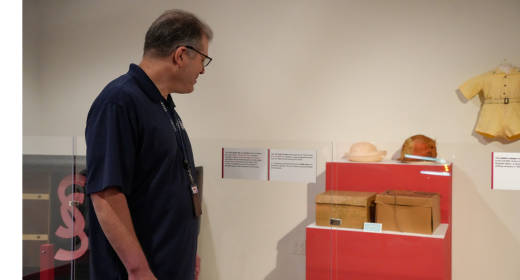
Jeff looking at his dad's credit card on display in Mississippi Made

Giambrone’s family has lived in central Mississippi since the 1920s, and he has donated many items to MDAH over the years. Three of these artifacts are now on display in Mississippi Made.

One is his dad’s 1967 credit card for The Emporium. Giambrone found it in a book, where it had been used as a bookmark. The Emporium was a department store in downtown Jackson until 1970. Giambrone’s father, J.T. Giambrone, was a banker, and he purchased suits at The Emporium.

Giambrone describes the downtown Jackson of his childhood as “vibrant.” He remembers the shift from department stores such as The Emporium to retail shopping centers like the Jackson Mall and the Metrocenter Mall – a shift that mirrored the national landscape. 

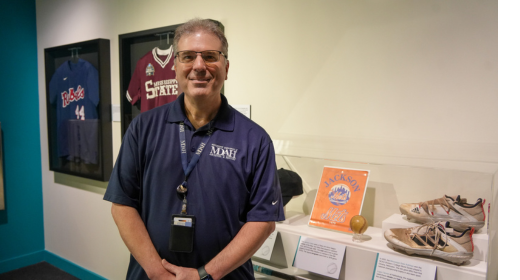
His two other items on display in Mississippi Made are both Jackson Mets artifacts. This farm team was a Class AA of the New York Mets and lasted from 1975 to 1990. Giambrone donated a baseball and a 1979 season program, both signed by members of the team. He remembers hanging out by the locker room to acquire the signatures of the popular baseball players. 

Jeff standing in front of the display with his donated Jackson Mets artifacts Giambrone was 12 when he caught the ball that is now on display. He and his family would attend many of these games at Smith-Wills Stadium. He describes the big crowds and atmosphere as “traditional Americana at its finest.” 

Farm teams like the Jackson Mets were often seen as a pipeline to the major leagues, which inspired even more excitement around local teams, he said.

 “These are the stories we need to preserve, particularly because they get lost the easiest,” Giambrone said. 

Anyone can donate to MDAH’s collections. To learn more, visit https://www.mdah.ms.gov/collections/donate-to-mdah-collections.

Mississippi Made is a free temporary exhibit on display until November 6, 2026. 

Section

Community Curation Day

Learn how to preserve treasured family artifacts at 10 a.m. on Saturday, July 15, for our Community Curation Day at the William F. Winter Archives & History Building. Professional archivist Laura Heller will demonstrate how to best preserve and store precious family memorabilia. Some archival supplies while be available while supplies last. This program is free and open to the public. Space is limited. Register here to reserve a spot. 

Eudora Welty Digital Archives Launches Online

Mississippi Department of Archives and History (MDAH) is pleased to announce that The Eudora Welty Digital Archives is now available to the public on the MDAH website. This digitization project was funded by a grant from the National Endowment for the Humanities with a matching contribution from the Eudora Welty Foundation

The Eudora Welty Digital Archives represents only a sample of Welty-related material housed at MDAH and features selections of correspondence, manuscripts, photographs, and other media related to Eudora Welty (1909-2001), master of the short story and one of America's greatest authors. 

"MDAH is grateful to the National Endowment for the Humanities for their generous grant which allowed for the construction of the world's most extensive digital archive of Eudora Welty materials," said Katie Blount, director of MDAH. "We are excited to share this incredible resource with researchers and fans of Eudora Welty."

Eudora Welty had a long relationship with the MDAH, making her first donation of manuscripts, papers, and photographs in 1957, and continuing to donate throughout her life. In addition to documents, the collection includes the house where Welty lived most of her life and wrote her greatest works, her furniture, art, and books, and the garden in which she worked alongside her mother. The complete collection is accessible at the MDAH.

Eudora Welty was born on April 13, 1909, the daughter of Christian Webb Welty and Chestina Andrews Welty. In 1925 the family moved to 1119 Pinehurst Street in Jackson, where Welty would reside until her death. Welty graduated from Jackson's Central High School in 1925, attended Mississippi State College for Women, University of Wisconsin, and Columbia University in New York City.

She received a Guggenheim Fellowship and the 1973 Pulitzer Prize for her book, The Optimist's Daughter—originally published in The New Yorker in 1969. Welty was also an accomplished photographer.

From 1955 to 1970, Eudora Welty published two short stories dealing with the Civil Rights Movement, "Where Is the Voice Coming From?" and "The Demonstrators," and worked on scenes for a novel while caring for her family.  

Eudora Welty died in Jackson on July 23, 2001. 

Any views, findings, conclusions, or recommendations expressed in this database do not necessarily represent those of the National Endowment for the Humanities.                              

For more information call 601-576-6850, or email info@mdah.ms.gov.   

Section

MDAH Accepting Applications For 2023 Eudora Welty and Medgar and Myrlie Evers Research Fellowships

The Mississippi Department of Archives and History (MDAH) is accepting applications for the 2023 Eudora Welty Research Fellowship and the 2023 Medgar and Myrlie Evers Research Fellowship. The competitive scholarships may be used for research at MDAH for a minimum of two weeks during the summer.   

Offered in partnership with the Eudora Welty Foundation, the annual Eudora Welty Research Fellowship awards a $5,000 stipend to one graduate student to conduct research using the Eudora Welty Collection at MDAH for at least two weeks during the summer. The deadline is March 3, 2023. 

The Eudora Welty Collection is the world’s finest collection of materials related to Welty and one of the most varied literary collections in the United States. The collection is divided over forty-five series and includes manuscripts, correspondence, photographs, drawings, essays, family papers, and audio and visual material that spans Welty’s entire life. 

The Medgar and Myrlie Evers Research Fellowship is in partnership with the Medgar and Myrlie Evers Institute and awards a $5,000 stipend to one graduate student or faculty member within the first five years of their academic career to conduct research using the Medgar Wiley and Myrlie Beasley Evers Papers at MDAH for at least two weeks during the summer. The deadline is March 24, 2023. 

The Medgar Wiley and Myrlie Beasley Evers Papers at MDAH include Evers and Beasley family papers dating from the early 1900s to around July 1964, when Myrlie Evers and her children moved to Claremont, California. The papers are divided into four subgroups: the papers of Medgar Evers as Mississippi field secretary of the NAACP; family papers of Medgar Evers; family papers of Myrlie Evers; and records relating to the case of the State of Mississippi v. Byron De La Beckwith. 

For more information about the fellowships visit https://www.mdah.ms.gov/careers-volunteering/fellowship-opportunities.  

For additional information and questions about the Eudora Welty Fellowship, email ecambonga@mdah.ms.gov

For additional information and questions about the Medgar and Myrlie Evers Fellowship, email lheller@mdah.ms.gov

Section

Advanced African American Research

Curious about tracing your roots in Mississippi but could use some guidance in interpreting complex records? Come to the Advanced African American Research workshop presented by Joyce Dixon-Lawson at 10 a.m. on Saturday, July 23. Centered around local and state records related to property, this workshop will guide you through the web of genealogical records, showcasing examples of wills, deeds, educable children records, and cemetery records.

Community Curation Day: Preserving Family Photos

Learn how to preserve your family photos for future generations to enjoy at our Community Curation Day: Preserving Family Photographs workshop. MDAH’s professional archivists will demonstrate sleeving and storing techniques. Archival supplies will be provided for guests to use while supplies last. This program is free and open to the public. Space is limited. Register at https://tickets.mdah.ms.gov/Info.aspx?EventID=12

Break Through Brick Walls

A brick wall is not the end of the line for family research. Join professional genealogist Kim Richardson on Saturday, April 30, at 10 a.m. for Break through Brick Walls, a Zoom presentation about the most common oversights in genealogy research and how to overcome the supposed dead-end search for a particularly hard to find ancestor. Registration is free and space is limited. Click here to register online.